

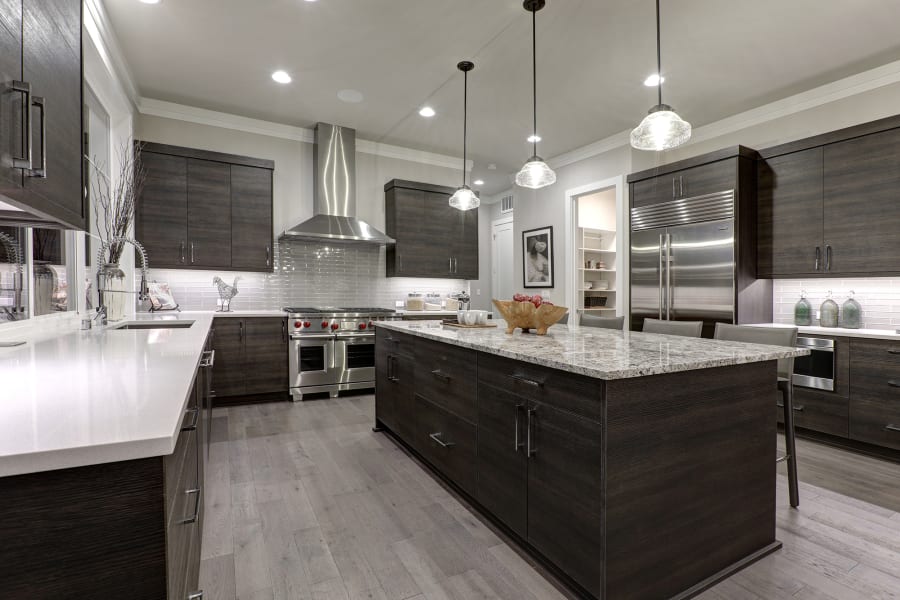
Two-toned kitchen cabinets aren’t a trend anymore. They’re a design staple. Homeowners across the Texas Hill Country are choosing this look because it feels custom, intentional, and anything but cookie-cutter. Done right, two-toned cabinets add depth, balance, and personality to your kitchen without overwhelming the space.
At M&M Quartz and Surfaces, we often see it in our showroom and warehouse. Clients walk in unsure, then leave excited once they see how two-toned cabinets can completely transform a kitchen. This guide breaks it all down: what works, what doesn’t, and how to get it right the first time.
What are two-toned kitchen cabinets?
Two-toned kitchen cabinets use two different colors, finishes, or materials in the same kitchen design. Most often, this means one color for upper cabinets and another for lower cabinets.
However, it can also include islands, pantry walls, or specialty cabinetry.
The goal isn’t contrast for the sake of contrast. It’s to balance. Two-toned cabinetry helps define zones, anchor the space, and make the kitchen feel layered and custom-built.
And yes, this approach works beautifully in everything from modern Hill Country homes to classic Texas ranch styles.
Why two-toned cabinets work so well
Two-toned cabinets aren’t just about looks. They solve real design challenges.
First, they add visual interest without clutter. Instead of busy tile or bold patterns everywhere, cabinetry does the heavy lifting.
Second, they help manage scale. Dark lower cabinets ground the room. Lighter uppers keep it open and bright. This is especially helpful in kitchens with lower ceilings or limited natural light.
Third, they allow more flexibility with countertops, backsplashes, and hardware. You’re not locked into one color story.
Simply put, two-toned cabinets offer more design freedom and a higher-end result.
Popular two-toned cabinet combinations we love
Some combinations stand the test of time. Others push boundaries just enough to feel fresh.
Light uppers with dark lowers: This is the most popular choice, and for good reason. White, cream, or light gray upper cabinets paired with navy, charcoal, or deep green lowers feel clean and grounded. It’s a safe option that still feels elevated.
White perimeter with a bold island: Keeping the main cabinets neutral while using a contrasting island color creates a focal point without overwhelming the room. Think white cabinets with a warm wood or rich blue island.
Wood and painted cabinets: Mixing natural wood with painted cabinetry adds warmth and texture. This works especially well in homes where natural materials feel right at home.
Soft neutrals with subtle contrast: Not all two-toned kitchens need drama. Pairing warm beige with greige or soft gray creates depth without strong contrast.
We help clients see these combinations in person, side by side, so nothing feels like a guess.
How countertops tie the look together
Cabinets set the tone. Countertops bring it all together.
With two-toned cabinets, countertops act as the visual bridge between colors. This is where material choice matters.
Quartz countertops are especially popular because they’re consistent, durable, and available in a wide range of styles. A clean white quartz can unify contrasting cabinets. A veined stone look can add movement and soften transitions.
At our 10,000 sq. ft. warehouse, you can walk through full stone slabs (not small samples) and see exactly how your cabinets and countertops will work together. That clarity makes all the difference.
Choosing the right cabinet finishes and hardware
Finish choices can make or break a two-toned kitchen.
Matte finishes feel modern and subtle. Satin or soft sheen finishes reflect light without feeling glossy. Mixing finishes between cabinet colors can add another layer of interest.
Cabinet hardware matters just as much. Black hardware creates bold contrast. Brushed brass adds warmth. Polished chrome keeps things clean and timeless.
We often recommend choosing one cabinet hardware finish throughout the kitchen to keep the look cohesive, even when cabinet colors differ.
Common mistakes to avoid
Two-toned cabinets are powerful, but only when done thoughtfully.
One mistake we see often is too much contrast without balance. Extremely dark and extremely light colors need a neutral element (like countertops or backsplash) to connect them.
Another issue is ignoring the rest of the home. Kitchens don’t exist in isolation. Cabinet colors should flow naturally into nearby spaces.
Finally, skipping professional guidance can lead to regret. Lighting, flooring, wall color, and ceiling height all affect how cabinet colors read.
That’s why seeing everything together (in one place) matters.
Why custom and semi-custom cabinets matter here
Two-toned designs shine brightest when cabinetry fits the space perfectly.
Custom and semi-custom cabinets allow flexibility in layout, color, finish, and storage. Want a different color on the island? Easy. Need custom pantry cabinets in a complementary tone? Done.
At M&M Quartz and Surfaces, cabinetry isn’t an afterthought. It’s part of an all-in-one process that includes cabinets, countertops, stone slabs, sinks, and more, designed to work together from day one.
Your source for high-quality cabinets in Hill Country
We’re family-owned, local, and genuinely care about getting it right.
Our unique showroom and warehouse experience lets you see cabinets, countertops, and stone slabs together, not in isolation.
From our showroom in Marble Falls, TX, we serve the Texas Hill Country, including Marble Falls, TX, San Antonio, TX, Austin, TX, Fredericksburg, TX, Johnson City, TX, and Lago Vista, TX, with integrity, craftsmanship, and personalized service. Every project matters to us because every home matters to us. Call or stop by M&M Quartz and Surfaces today!